The establishment of the European Union (EU) represents one of the most important geopolitical experiments in modern history. Far from being a sudden bureaucratic invention, the European Union emerged as a calculated response to the devastation of the Second World War, driven by a specific set of ideological, religious and strategic imperatives. I want to introduce the fundamental dynamics of the Bloc, tracing its evolution from a desperate effort for peace to a complex monetary and political entity.
1. The Background of European Union History#
The intellectual origins of the European Union were the result of the trauma of what happened between 1939-1945. With the continent’s state of being physically ruined and morally bankrupt, the post-war order required a radical departure from the nation-state nationalism that had led to two world wars.
1.1 Konrad Adenauer, Robert Schuman, Jean Monnet#
The architecture of the EU was primarily drafted by three characters, as we can refer to as the “Founding Fathers.”
Jean Monnet: A French political economist. He conceived the “Monnet Plan,” which proposed functionalist integration, starting with specific economic sectors to create a de facto solidarity.
Robert Schuman: The French Foreign Minister who gave political voice to Monnet’s ideas. The Schuman Declaration of 1950 is widely regarded as the birth certificate of the EU, proposing the pooling of French and German coal and steel production.
Konrad Adenauer: The first Chancellor of West Germany. Adenauer sought the rehabilitation of Germany on the world stage. He recognized that the only way for Germany to regain sovereignty and trust was to bind itself irrevocably to the West.
1.2 Christianity as a Unifier#
It is impossible to analyze the early EU without acknowledging the role of Christian Democracy. Adenauer, Schuman, and Italian leader Alcide De Gasperi were all devout Catholics and leaders of Christian Democratic parties. They shared a vision of Europe that transcended national borders, rooted in the concept of Christendom, a pre-Westphalian idea of a united moral community. This shared faith provided a “supra-national” identity that helped bridge the deep historical bonds between their nations, which has been serving as a spiritual glue for the new political structure.
2. European Union as a Peacemaker#
The primary objective of early European integration was not economic prosperity, but existential survival.
2.1 No More War Between France and Germany#
The “German Question” dominated French foreign policy. The European Coal and Steel Community (ECSC), established in 1951, was designed to solve this by placing the raw materials of war, coal and steel, under a supranational High Authority. By pooling these resources, France and Germany made war between them not only unthinkable but, in Schuman’s words, “materially impossible.”
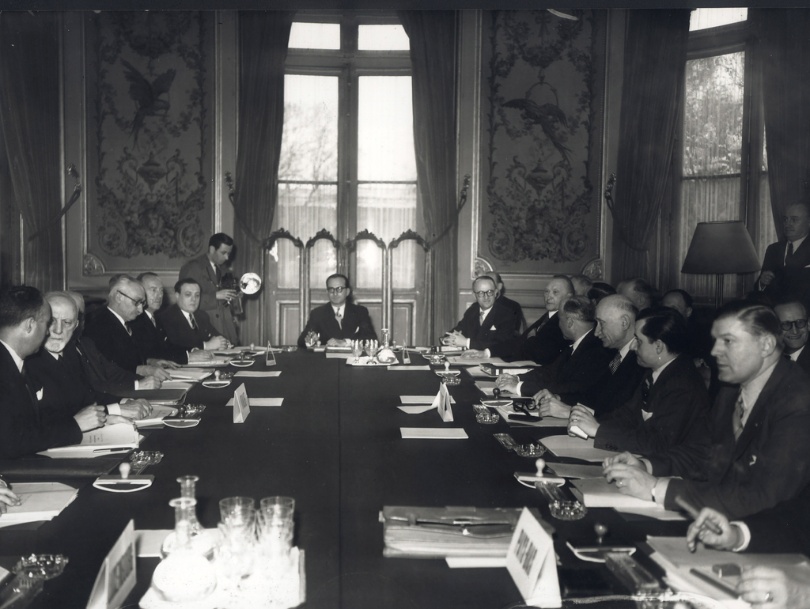 The Foreign Affairs Ministers of the six countries participating in the Schuman Plan negotiating the Treaty of Paris - Konrad Adenauer, Paul van Zeeland, Carlo Sforza; Joseph Bech, Dirk Stikker and Robert Schuman - Creation of the European Coal and Steel Community (ECSC) © European Union

2.2 The End of the Prussian Politics#
The integration project signaled the definitive end of “Prussian politics”; the militaristic, state-centric tradition that had unified Germany through “blood and iron” in the 19th century. The new Federal Republic of Germany (West Germany), under Adenauer’s leadership, rejected this distinct Sonderweg (special path) and instead embraced Westbindung (integration with the West), which transformed Germany from a military power into a civilian trading state.
2.3 NATO + European Union#
The European project did not exist in a vacuum; it was symbiotic with the North Atlantic Treaty Organization (NATO). While the EU (then the European Communities) focused on economic and political stabilization, NATO provided the necessary security umbrella. The US security guarantee meant that Western European nations did not need to fear immediate military aggression from the Soviet Union or from one another, allowing them to focus their resources on building the welfare state and economic integration.
3. EU Started as a Defence Union#
While the EU is known today as an economic giant, its early DNA contained a failed attempt at a defence union. In the early 1950s, amidst fears of the Korean War spilling over into Europe, France proposed the European Defence Community (EDC).
This plan envisioned a pan-European army, including German units, under a single European command. It was a radical step toward a federal Europe. However, the French National Assembly rejected the treaty in 1954, fearing the loss of national military sovereignty. The failure of the EDC forced the Founding Fathers to pivot back to economics (the Treaty of Rome in 1957), but the initial impulse confirmed that security and defence were the original drivers of integration.
4. How Come the Euro Was Accepted?#
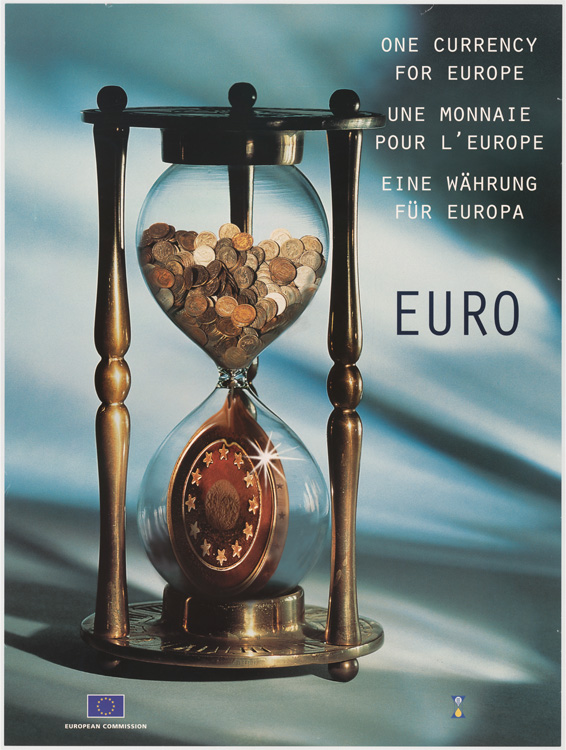
The creation of the Euro was arguably the most significant deepening of the Union, yet it was born of political necessity rather than pure economics.
The acceptance of the Euro is inextricably linked to the reunification of Germany in 1990. France, led by François Mitterrand, feared that a reunified Germany would become too powerful and dominant in Europe again. The Deutsche Mark was the symbol of German economic might.
In a historic geopolitical trade-off, France agreed to support German reunification, but on the condition that Germany surrender the Deutsche Mark and join a single European currency. This would bind the enlarged Germany into a European structure so tightly that it could never act unilaterally again. Thus, the Euro was accepted not merely to lower transaction costs, but as a political instrument to contain German power within a European framework.
5. Conclusion#
The establishment of the European Union was a process of turning historical enemies into partners through functional integration. From the ideological alignment of its Christian Democratic founders to the strategic pooling of coal and steel, the EU was built as a peace project first and an economic market second. By ending the era of Prussian militarism and anchoring Germany within a Euro-Atlantic framework, the Union successfully replaced the battlefield with the conference table, creating a unique post-national entity in international relations.